You bought HubSpot, Apollo, Clay, and three intent tools. Congratulations, you own five disconnected databases.
The real competitive advantage in GTM isn't which tools you buy. It's whether those tools actually talk to each other. Most companies treat their data stack like a shopping list. The ones compressing sales cycles treat it like a unified system.
Related Reading
Why Revenue Growth Is Fundamentally A Technical Problem
How Context Engineering Changes Everything For Gtm Teams
Scope Clay As Infrastructure Across Your Entire Revenue Org
The Stack You Built Is Working Against You
◆ The point
Most B2B revenue teams have between four and eight tools in their stack. CRM, enrichment, intent data, sequencing, analytics, maybe a data warehouse. Each one was purchased to solve a specific problem. And each one did, in isolation.
◆ The detail
The issue isn't the tools. It's the space between them. Your CRM holds account data but doesn't know that Apollo just found a new VP of Engineering at a target account. Your intent provider flags a company researching your category, but that signal dies in a dashboard nobody checks. Clay enriches contacts beautifully, but the enriched data sits in a table disconnected from your sequencing tool.
The root cause is tool fragmentation. Most B2B data stacks grow by acquisition, not by design. Each new tool adds another silo, another format, another sync to maintain.
◆ Real-life example
A Series B SaaS company we audited had $87,000 in annual tool spend across six platforms. When we mapped the data flow, we found that fewer than 12% of records in their CRM had been touched by more than one tool. The other 88% existed in exactly one system, invisible to the rest of the stack. They were paying for six databases, not one revenue engine.
Why Fragmentation Gets Worse, Not Better
◆ The point
Data fragmentation is a compounding problem. Every new tool you add without integration multiplies the disconnection. Every manual export-import cycle introduces decay. Every quarter that passes without a unified data model makes the eventual fix more expensive.
This is what revenue infrastructure actually looks like: a data integration layer that treats your entire data stack as one system, not a collection of disconnected platforms.
◆ The detail
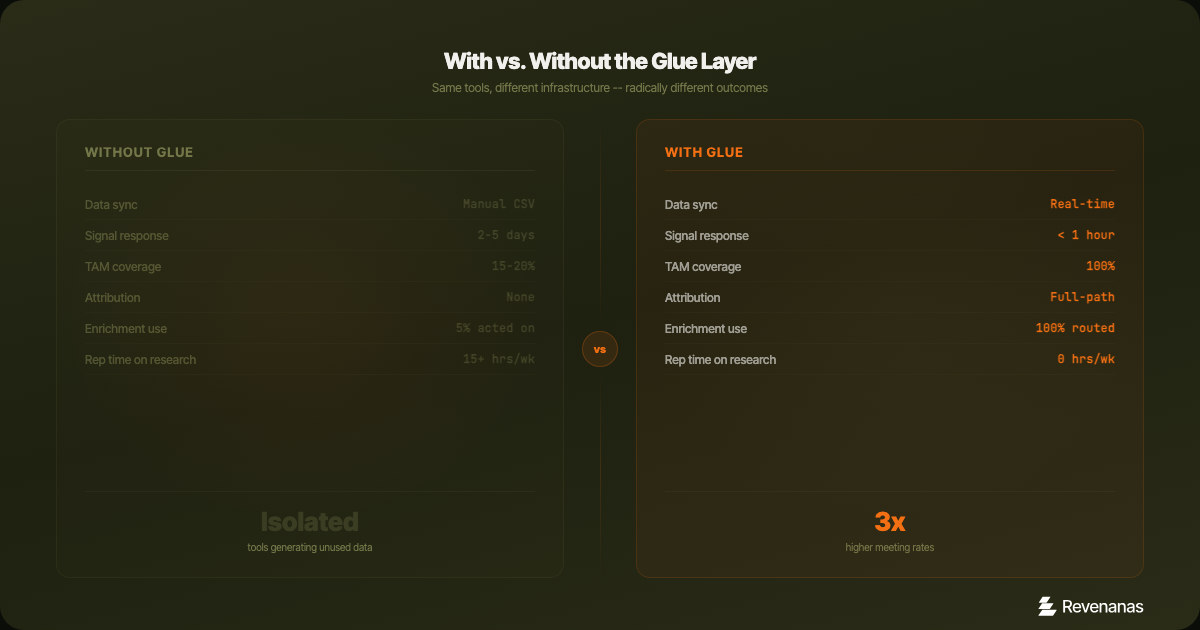
Here's what the decay cycle looks like in practice. Marketing builds an ICP list in one tool. Sales enriches a subset in another. RevOps tries to reconcile the two in a spreadsheet. By the time the "clean" list reaches a sequencing tool, 15-20% of the contacts have changed jobs, companies have merged, or the buying window has closed. The team blames "bad data" when the real problem is latency caused by manual glue work.
◆ The cost nobody calculates
Beyond tool spend, the hidden cost is human time. We've measured this across multiple client engagements: reps spend 8-15 hours per week on manual research, cross-referencing tools, and updating records by hand. That's 30-40% of selling time burned on work that infrastructure should handle. At an average AE salary of $120,000, that's roughly $40,000 per rep per year in wasted capacity.
What "Building the Glue" Actually Means
Building the glue is not about buying another tool. It's about engineering the connective tissue between the tools you already own. Think of it as plumbing: the pipes matter more than the fixtures.
1. A Unified Data Model
■ The point
Before connecting anything, you need a single schema that defines how accounts, contacts, signals, and activities relate to each other across every tool in your stack.
■ The detail
This means mapping every field from every tool to a canonical set of properties. Your CRM's "Company Name" field, Apollo's "Organization," and Clay's "Company" all need to resolve to one entity. The same applies to contacts, deal stages, and signal types. Without this mapping, every integration you build is fragile; it breaks the moment a field name changes or a new tool enters the stack.
In practice, a unified data model looks like a document (or a database schema) that answers three questions:
- What are our core entities? Accounts, contacts, opportunities, signals, activities.
- What are the canonical fields for each entity? Company name, domain, industry, employee count, signal type, signal date, source system.
- What is the hierarchy? Signals belong to contacts. Contacts belong to accounts. Activities belong to opportunities.
2. Automated Data Pipelines
■ The point
Once you have the model, you build the pipes. Every enrichment, every signal detection, every contact update should flow automatically from source to destination without a human touching a spreadsheet.
■ The detail
The pipeline architecture follows a simple pattern: detect, enrich, route, act. A signal fires (job change, funding round, intent spike). The pipeline enriches the record with context from your other tools. It routes the enriched signal to the right owner based on territory or account assignment. Then it triggers the appropriate action, whether that's a Slack alert, a CRM task, or a sequence enrollment.
The key principle: no signal should require a human to move it from one system to another. If your reps are copying data between tabs, you have a pipeline gap.
3. A Single Source of Truth
■ The point
Every team, from marketing to sales to RevOps, needs to look at the same data. Not "similar" data in different tools. The same data, from the same source, updated in real time.
■ The detail
This doesn't always mean one tool. It means one authoritative record per entity. Your CRM might be the source of truth for deal data. Your enrichment platform might be authoritative for firmographics. Your intent provider might own signal data. The glue ensures that when any source updates, every downstream system reflects the change within minutes, not days.
Companies that get this right see measurable impact. One client reduced their sales cycle by 18 days after unifying their signal and CRM data, because reps stopped wasting the first two weeks of every deal re-researching information that already existed somewhere in the stack.
4. Signal-to-Action Mapping
■ The point
The final layer is connecting specific signals to specific actions. Not every signal deserves the same response. A champion job change and a generic website visit are not equal events.
■ The detail
Build a signal hierarchy that maps each trigger to a playbook:
- Tier 1 (immediate action): Champion job change, funding announcement, direct competitor displacement. These get a Slack alert to the account owner within the hour and a personalized sequence within 24 hours.
- Tier 2 (same-day action): Intent spike above threshold, new decision-maker hired, company expansion signal. These get routed to the right rep with context and a recommended next step.
- Tier 3 (batch processing): Website visits, content downloads, generic intent. These get scored, enriched, and added to nurture sequences on a daily cadence.
Without this mapping, teams treat every signal the same way, which means they treat none of them well.
The Funding Winter Makes This Urgent
◆ The point
When budgets were loose, you could afford redundant tools and manual processes. In a tighter market, every dollar of stack spend faces scrutiny. CFOs are asking a simple question: what is the ROI on each tool we pay for?
◆ The detail
Most teams cannot answer that question because the value of individual tools is invisible when they operate in silos. You can't measure the ROI of your intent provider if the signals it generates never reach a rep. You can't justify your enrichment spend if the enriched data sits in a standalone table. The only way to demonstrate tool ROI is to show the complete chain: signal detected, record enriched, action taken, pipeline generated.
◆ The strategic advantage
Companies that build unified infrastructure during a downturn gain a structural edge. While competitors are cutting tools and losing coverage, you're making your existing tools work harder. When the market recovers, you have a system that scales. They have a stack they need to rebuild from scratch.
When to Use This Approach (and When Not To)
◆ This is the right move when:
You have three or more tools in your GTM stack that don't share data automatically. Your reps spend significant time on manual research. Your marketing and sales teams disagree on which accounts to target. You're paying for intent data that nobody acts on. You've tried point-to-point integrations (Zapier, native connectors) and they keep breaking.
◆ This is not the right move when:
You're pre-product-market-fit and your ICP is still shifting weekly. You have fewer than three tools and can manage data flow manually without pain. Your sales cycle is transactional (under 7 days) and signal-based selling adds more complexity than value. You don't have someone (internal or fractional) who can maintain the infrastructure after it's built.
◆ A word of caution
Building the glue is an infrastructure project, not a one-time setup. It requires ongoing maintenance as tools update their APIs, your ICP evolves, and your team's workflows change. The investment pays off when you treat it as a permanent internal asset, not a project with an end date. Budget 2-4 hours per week for maintenance and iteration once the core system is live.
A Practical Roadmap: From Fragmented to Unified
◆ Step 1: Audit the current state
Map every tool in your stack. For each one, document what data it holds, where that data comes from, and where it goes. Count the manual handoffs. This audit typically takes 1-2 days and reveals gaps you didn't know existed.
◆ Step 2: Define the canonical data model
Pick your core entities (accounts, contacts, signals, activities) and define the authoritative source for each field. Write it down. This becomes the contract that every integration respects.
◆ Step 3: Build the first pipeline
Don't try to connect everything at once. Pick the highest-value signal (usually champion job changes or intent spikes above threshold) and build the complete chain: detection, enrichment, routing, action. Prove the model works end-to-end before expanding.
◆ Step 4: Expand and automate
Once the first pipeline is validated, add more signals, more enrichment sources, and more action triggers. Each new pipeline follows the same pattern, so the marginal cost of adding the next one drops significantly.
◆ Step 5: Measure and iterate
Track three metrics: signal-to-action time (how fast a detected signal becomes a rep action), data coverage (percentage of your TAM that's enriched and monitored), and pipeline attribution (how much pipeline can be traced back to a specific signal). These numbers tell you whether the glue is working.
Key Takeaways
- Your tools are not the problem. The space between them is. Most stack ROI is destroyed by manual handoffs and disconnected data, not by bad tools.
- Data fragmentation compounds over time. Every quarter without a unified model makes the fix more expensive and the decay harder to reverse.
- The glue is infrastructure, not another tool. You need a data model, automated pipelines, a single source of truth, and signal-to-action mapping. No single vendor sells all four.
- Start with one high-value pipeline. Prove the model works end-to-end before expanding. Champion job changes or high-intent signals are the best starting point for most teams.
- Tighter budgets make this more urgent, not less. The companies building unified infrastructure during a downturn will have a structural advantage when the market recovers.
- This is a permanent asset, not a project. Budget for ongoing maintenance. The teams that treat their data infrastructure as a living system outperform those that treat it as a one-time build.
The Bottom Line
Your data stack is either a liability or an asset. The difference isn't which tools you chose. It's whether you built the connective tissue that makes them work as one system. The companies compressing sales cycles and surfacing signals their competitors can't see aren't using better tools. They're using the same tools, connected by infrastructure they own.
The glue is the asset. Everything else is just a line item on your SaaS bill.