The age of ambient AI context is here.
We spent a decade teaching AI to answer questions. Now the race is on to build AI that watches, understands, and acts on what you actually do all day. For revenue teams, this shift changes everything about how you think about tooling, data, and competitive advantage.
Related Reading
Why Context Engineering Is Your Next Gtm Superpower
Measuring The Revenue Ai Actually Generates
The Signal Infrastructure Replacing Legacy Data Subscriptions
The Problem: AI That Can't See Your Work
◆ The point
Most AI tools operate blind. They wait for you to type a prompt, paste some context, or click a button. They have no idea what you were doing five seconds ago, what tab you have open, or what deal you just reviewed. Every interaction starts from zero.
◆ The detail
This is the fundamental bottleneck in AI-assisted revenue work today. Your SDR spends 40 minutes researching a prospect, builds a mental model of the account, then opens an AI writing tool and has to re-explain everything they just learned. Your AE reviews a call transcript, identifies three objections, then switches to a forecasting tool that knows nothing about that conversation. The context your team builds through their daily workflow evaporates the moment they switch tools.
◆ Real-life example
A sales team we work with uses six different tools in their daily workflow: CRM, email, call recorder, prospecting platform, content library, and a chatbot for writing. Each tool holds a fragment of context. None of them talk to each other in real time. The rep is the integration layer, manually carrying context between systems. That is not a productivity problem. It is an architecture problem.
The Three Layers of Context Infrastructure
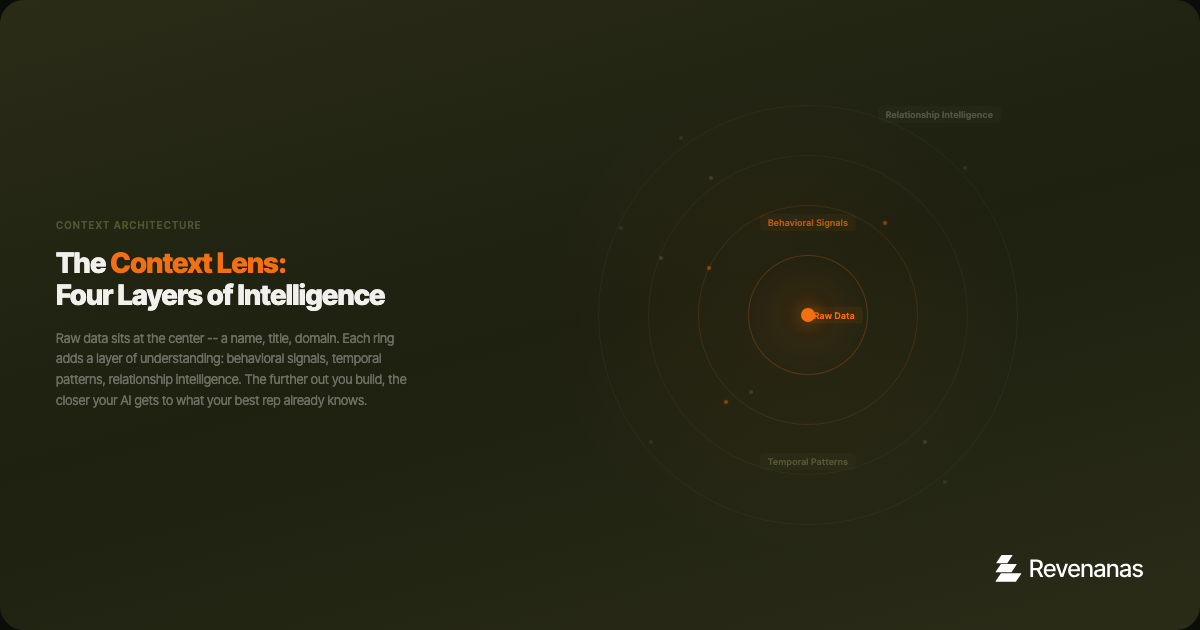
Not all context is created equal. Understanding the layers helps you decide where to invest.
1. Capture Layer: What Does the AI Actually See?
■ The point
The capture layer determines what raw information flows into your AI systems. Screen reading, API events, CRM updates, email threads, call transcripts. This is the sensory input.
■ The detail
Littlebird is betting on the screen as the universal capture surface. Everything a knowledge worker does eventually appears on screen, so reading the screen captures context that no single API integration can match. But screen capture is noisy. The real engineering challenge is not capturing the data; it is filtering signal from noise at the capture layer.
Other approaches capture context through:
- API event streams: CRM field changes, email opens, meeting bookings. Structured but narrow.
- Call transcripts: Rich conversational context, but only covers phone and video interactions.
- Browser activity: Which pages your team visits, what they research. Broad but raises privacy questions.
The teams getting the most value combine multiple capture methods, using structured API data as the backbone and layering in unstructured signals from calls and research activity.
2. Understanding Layer: Making Sense of Raw Context
■ The point
Raw context is useless without interpretation. The understanding layer transforms screen pixels, API events, and transcript fragments into structured knowledge: account profiles, buyer intent signals, competitive positioning, and relationship maps.
■ The detail
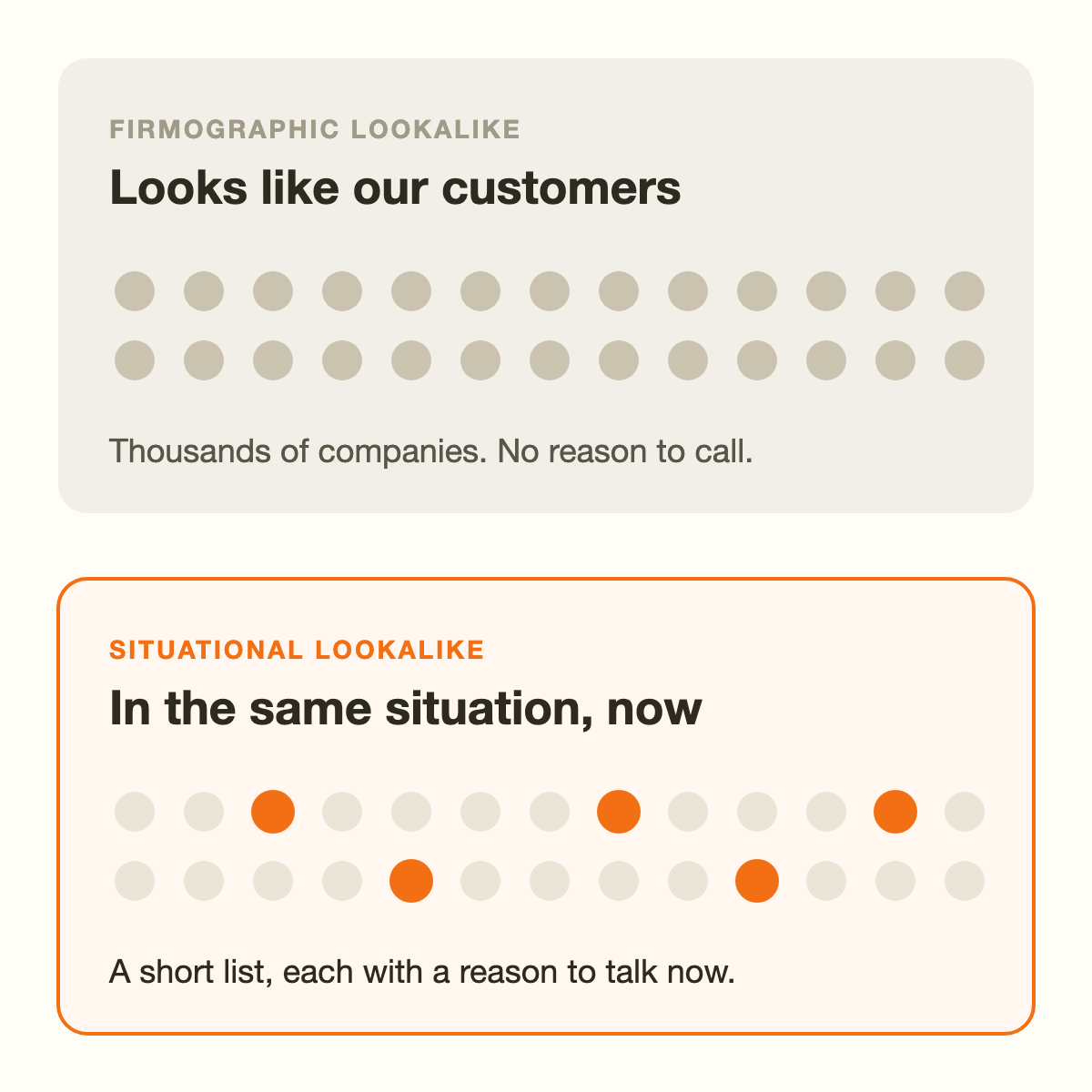
This is where most teams underinvest. They connect data sources, build dashboards, and call it done. But dashboards are not context. Context is the interpreted, connected, and prioritized understanding of what matters right now for a specific deal, account, or persona.
LangSmith's Fleet launch signals where this layer is heading. Managing dozens or hundreds of AI agents that each handle a slice of understanding, one agent monitors competitor pricing, another tracks hiring signals, a third synthesizes call themes. The orchestration of these agents, making sure they share context and do not duplicate work, is the real engineering problem.
At Revenanas, we have been building what we call ContextOS for clients: a knowledge layer that sits between raw data sources and AI-powered actions. It maintains a living model of each account, updated continuously from CRM data, enrichment APIs, call transcripts, and market signals. When an AI agent needs to write an email or score a lead, it queries ContextOS instead of starting from scratch.
3. Action Layer: Context-Driven Execution
■ The point
The action layer is where context becomes revenue. AI agents that can see your workflow, understand the account context, and execute the right action at the right time.
■ The detail
This is the layer everyone wants to skip to. Teams buy AI writing tools, AI dialers, AI scheduling assistants, but plug them into thin or stale context. The result is generic output that requires heavy human editing, which defeats the purpose.
The action layer only works when the capture and understanding layers are solid. A few patterns that work well:
- Context-aware email generation: The AI has read the last three calls, knows the prospect's tech stack, and understands the competitive landscape. The draft it produces is specific, relevant, and needs minimal editing.
- Intelligent lead scoring: Instead of static rules (title + company size + industry), the scoring model incorporates real-time signals: recent funding, hiring patterns, technology adoption, and engagement history.
- Automated research briefs: Before every meeting, an agent compiles a brief from all available context. Not a generic company overview, but a synthesis of your relationship history, recent interactions, and relevant market moves.
When to Use This (and When Not To)
Ambient context infrastructure is powerful, but it is not the right investment for every team. Here is an honest assessment.
This shift matters most for AI revenue operations. When your AI tools operate on stale, fragmented context, they produce generic outputs. Context engineering solves this by building a live infrastructure layer that feeds your revenue teams the same picture in real time.
◆ Build context infrastructure when:
- Your team uses 5+ tools daily and spends significant time re-entering context between them
- Your sales cycle is complex, involving multiple stakeholders and long research phases
- You have enough deal volume that manual context-carrying does not scale
- Your competitive advantage depends on speed of personalized outreach
◆ Skip it (for now) when:
- Your team is under 5 people and can carry context manually without bottlenecks
- Your sales motion is transactional with short cycles and minimal research
- You have not yet nailed your ICP and messaging. Context infrastructure amplifies your playbook, so you need a playbook first
- Your data hygiene is poor. Garbage context at scale is worse than no context
The honest truth: most teams under 10 people get more ROI from fixing their CRM hygiene and building basic automations than from investing in ambient context. Start with clean data and simple workflows. Layer in context infrastructure as you scale.
How to Start Building Your Context Layer
You do not need to wait for Littlebird or any other vendor. You can start building context infrastructure today with existing tools.
◆ Step 1: Audit Your Context Gaps
Map every tool your revenue team uses. For each tool, answer: what context does it capture, and where does that context go? You will find that most context dies inside the tool that created it. Call insights stay in Gong. Research stays in browser history. Relationship context stays in the rep's head. Your first job is to identify the three biggest context leaks.
◆ Step 2: Build a Central Knowledge Store
Pick a system of record for account and contact context. This could be your CRM (if it is well-structured), a dedicated data warehouse, or a purpose-built knowledge layer. The key requirement: every AI tool in your stack should be able to read from and write to this store. If your AI email writer cannot access your call transcript summaries, you have a context gap.
◆ Step 3: Automate Context Flow
Set up automated pipelines that move context between systems. When a call ends, the transcript summary should flow to the account record. When a prospect visits your pricing page, that signal should appear in the next email draft. When a deal stage changes, the competitive intel should update. Use tools like n8n, Zapier, or custom integrations. The goal is zero manual context transfer.
◆ Step 4: Layer in AI Agents
Once your context flows automatically, you can start deploying AI agents that actually have enough information to be useful. Start with one high-value workflow: pre-meeting research briefs, or personalized email sequences, or lead scoring. Build the agent with full access to your context layer, measure the output quality, and expand from there.
The Competitive Reality
◆ The point
The teams that build context infrastructure now will compound their advantage over the next two to three years. This is not about having better AI models. It is about giving those models better raw material to work with.
◆ The detail
Here is the math that matters. Two competing sales teams use the same AI email tool. Team A plugs it into a rich context layer: call summaries, account research, competitive positioning, engagement history. Team B uses it with basic CRM data: name, title, company. Team A's emails are specific, timely, and relevant. Team B's emails are generic and templated. Over 1,000 prospects, Team A's reply rate is 3x higher. Same model, same tool, same cost. The difference is context.
The $11M bet on screen-reading AI, the agent fleet management platforms, the monitoring infrastructure for autonomous systems: these are all bets on the same thesis. The model layer is commoditizing. The context layer is where durable competitive advantage lives.
Revenue teams that treat context as infrastructure, not as a nice-to-have, will outperform those that keep buying more tools and hoping the AI figures it out.
Key Takeaways
- Context is the bottleneck, not intelligence. Better models with thin context produce worse results than average models with rich context.
- The three layers matter in order. Capture, understand, act. Skipping to the action layer without solid capture and understanding produces generic AI output.
- Start with context gaps, not tools. Audit where context dies in your workflow. Fix those leaks before buying new AI products.
- Not every team needs this today. If you are under 10 people with a simple sales motion, fix your CRM first. Context infrastructure pays off at scale.
- The context layer compounds. Every call, every research session, every deal interaction adds to your knowledge layer. Teams that start building now will have an insurmountable data advantage within two years.