The most valuable layer in your GTM stack isn't your CRM, your sequencer, or your intent tool. It's the signal infrastructure connecting them.
Every major platform shift in 2026 points to the same structural change: value is migrating from individual tools to the connective layer between them. Signal infrastructure, the system that detects, routes, and acts on buying signals in real time, is becoming the single most important investment in go-to-market. Companies that build it are compressing sales cycles by 30-50%. Companies that don't are watching pipeline decay in real time.
Related Reading
How Your Disconnected Data Stack Becomes A Liability
Clay As Revenue Infrastructure, Not Just An Sdr Tool
The Four Layers Of Revenue Infrastructure
The Tool Trap: Why More Software Isn't Fixing Pipeline
◆ The point
The average B2B sales team runs 12-15 tools. Pipeline quality has not improved in five years.
◆ The detail
There is a paradox at the center of modern GTM. Companies keep buying more software, more intent providers, more enrichment tools, more sequencers, and pipeline conversion rates stay flat or decline. The reason is architectural, not operational. Each tool generates its own signals in isolation. Your intent provider sees a surge. Your CRM logs an activity. Your sequencer fires a cadence. But nothing connects them. The signal dies in the gap between systems.
◆ Real-life example
A mid-market SaaS company runs Bombora for intent, HubSpot for CRM, and Outreach for sequences. A target account shows a 90th-percentile intent surge on Monday. The intent data syncs to HubSpot on Wednesday via a daily batch job. The SDR notices the flag on Friday. By the time an email goes out the following Monday, the buying window has closed. Seven days of latency turned a hot signal into a cold outbound. The tools all worked. The infrastructure between them didn't exist.
This is the core of signal-based outbound: instead of buying generic intent data, you engineer signals specific to your sales stack using tools like Clay and custom pipelines.
What Signal Infrastructure Actually Is
◆ The point
Signal infrastructure is not another tool. It is the connective layer that makes all your existing tools work together in real time.
◆ The detail
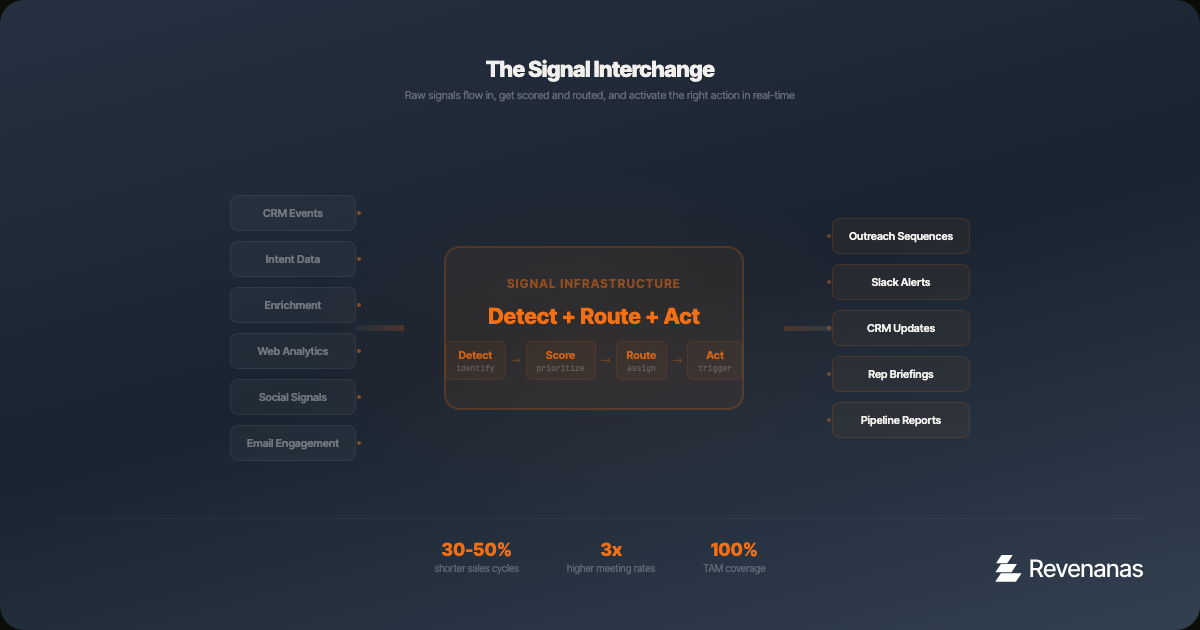
Think of it as the nervous system of your GTM stack. Individual tools are organs: they each do something useful. But without nerves connecting them, the body can't react. Signal infrastructure has three jobs: detect signals across every source (intent, product usage, CRM activity, web engagement, funding events), route them to the right person or system with context, and trigger the right action within minutes, not days.
◆ The detail
This is not workflow automation. It is not "if this, then that" with a Zapier connection. Signal infrastructure requires a data model that normalizes signals from different sources, a scoring layer that prioritizes them, and an orchestration engine that routes them with enough context for a human or AI agent to act immediately. The difference between a Slack notification that says "Acme Corp visited your pricing page" and one that says "Acme Corp, $45M ARR, 3 champion contacts identified, viewed pricing 4 times this week, currently in renewal with competitor" is the difference between noise and a closed deal.
What Signal Infrastructure Looks Like in Practice
This is not theoretical. Here is what a working signal infrastructure stack produces for real pipeline.
1. Detection: 100% TAM Monitoring
■ The point
Every account in your total addressable market is monitored for buying triggers, continuously, without manual effort.
■ The detail
Detection means ingesting signals from multiple sources simultaneously:
- Intent data: Topic surges from providers like Bombora or G2.
- Product signals: Trial activity, feature usage, support tickets.
- Web engagement: Pricing page visits, content downloads, return visits.
- Market events: Funding rounds, leadership changes, competitor contract renewals, earnings calls.
- Relationship signals: Champion job changes, mutual connections, past deal history.
The goal is not to collect every signal. It is to normalize them into a unified model so they can be scored and compared. A pricing page visit from a $500M account with two champions inside is worth more than an intent surge from a company outside your ICP. Without normalization, you can't make that distinction.
2. Routing: Right Signal, Right Person, Right Moment
■ The point
Signals are worthless if they reach the wrong person or arrive too late. Routing is where most stacks fail.
■ The detail
A working routing layer does three things:
- Prioritization: Composite scoring that weights signal type, account fit, timing, and relationship strength. Not every signal deserves action.
- Assignment: Automatic routing to the right owner based on territory, account history, and current capacity. No manual triage.
- Context packaging: The signal arrives with everything the rep needs to act: company summary, contact details, signal history, suggested next step, and relevant content.
The metric that matters here is time-to-action. In most organizations, the gap between signal detection and human action is 3-7 days. With proper routing infrastructure, it drops to under 30 minutes. That compression alone drives 3x higher meeting rates on signal-based outbound versus batch-and-blast sequences.
3. Action: Every Signal Becomes a Sales Trigger
■ The point
The final layer converts routed signals into concrete sales actions, automatically or with minimal human input.
■ The detail
Action orchestration means different responses for different signal strengths:
- High-confidence signals (champion job change + intent surge + ICP fit): Auto-draft a personalized email referencing the specific trigger, route to AE for review and send.
- Medium-confidence signals (intent surge, no relationship): Enroll in a targeted nurture sequence with signal-specific messaging.
- Low-confidence signals (single weak indicator): Log for pattern monitoring. If three weak signals cluster within 14 days, escalate to medium.
This is where AI agents start to matter. Not as autonomous sellers, but as systems that can draft context-rich outreach, research accounts, and prepare briefing docs while the human focuses on relationship building and deal strategy. The infrastructure routes the signal; the agent prepares the action; the human makes the judgment call.
When to Use This (and When Not To)
Signal infrastructure is not universally applicable. Here is an honest assessment of when it creates value and when it doesn't.
■ Build signal infrastructure when:
- Your sales cycle is 30+ days and involves multiple stakeholders.
- You sell to a defined TAM of 500-50,000 accounts (enough to monitor, few enough to act on individually).
- You already have 3+ signal sources but no connective layer between them.
- Your SDR team spends more time triaging than selling.
- You are losing deals because of timing, not product fit.
■ Skip it (for now) when:
- You sell a self-serve product under $5K ACV. The signal-to-noise ratio won't justify the investment.
- You have fewer than 2 signal sources. You need inputs before you need infrastructure.
- Your ICP is undefined. Signals without a filter are just noise at higher volume.
- You are pre-product-market-fit. Fix the product before optimizing the pipe.
The honest truth: signal infrastructure amplifies what's already working. If your messaging doesn't resonate, faster delivery of bad emails won't help. Get the fundamentals right first. Then build the infrastructure to scale them.
The Build vs. Buy Calculation
◆ The point
There is no off-the-shelf signal infrastructure product. This is an architecture, not an app.
◆ The detail
Some companies try to solve this by buying a "revenue orchestration" platform. The problem is that these platforms become yet another tool in the stack, one more system that needs to be integrated, maintained, and fed data. True signal infrastructure is built on top of your existing tools, not alongside them. It uses your CRM as the system of record, your existing intent providers as inputs, and your current sequencer as the action layer. It adds the connective tissue without adding another organ.
◆ Real-life example
We build signal infrastructure for B2B companies as fractional GTM engineers. A typical implementation takes 6-8 weeks and connects 4-6 existing tools into a unified signal layer. One client went from 3% reply rates on batch outbound to 11% reply rates on signal-triggered sequences. Their sales cycle compressed from 90 days to 52 days. The infrastructure cost less than a single enterprise software license. The difference was not a new tool. It was the architecture connecting the tools they already had.
Key Takeaways
- Individual tools are commoditized. Every company has access to the same intent data, enrichment APIs, and AI models. The infrastructure connecting them is the moat.
- Signal latency kills deals. The gap between detecting a buying signal and acting on it is the single biggest source of pipeline leakage. Compress it from days to minutes.
- Context beats volume. A signal with full context (company fit, relationship history, competitive timing) converts at 3x the rate of a raw trigger notification.
For GTM engineering teams, signal infrastructure is the foundation that replaces the traditional sales stack with something purpose-built and composable.
- Build on what you have. Signal infrastructure connects your existing stack. It does not replace it. Start with your top 2-3 signal sources and one action channel. Expand from there.
- Know when to wait. If your ICP is undefined, your messaging doesn't resonate, or you have fewer than two signal sources, fix the fundamentals first. Infrastructure amplifies; it doesn't create from nothing.
Where This Goes Next
The convergence of AI agents, real-time data infrastructure, and signal-based selling is accelerating. Within 18 months, the companies that built signal infrastructure will operate with a structural advantage that's nearly impossible to replicate quickly. Their systems will learn which signals convert, which routing rules work, and which actions close deals. That compounding data advantage is the real moat.
The companies still running batch-and-blast outbound on disconnected tools will wonder why their pipeline keeps shrinking despite buying more software. The answer will be the same as it is today: they invested in tools when they should have invested in infrastructure.
Every marketing signal should become an immediate sales trigger. That is not a vision statement. It is an engineering problem. And it is solvable right now.