Signal
Amazon Q2 2026: $200.6B Revenue, AWS Grows 36.7%, CapEx Raised to $220B

September 5, 2026
AI & Data
Signal
Key Facts
Signal Type
Signal
Industry
AI & Data
Companies
Amazon
Date
September 5, 2026
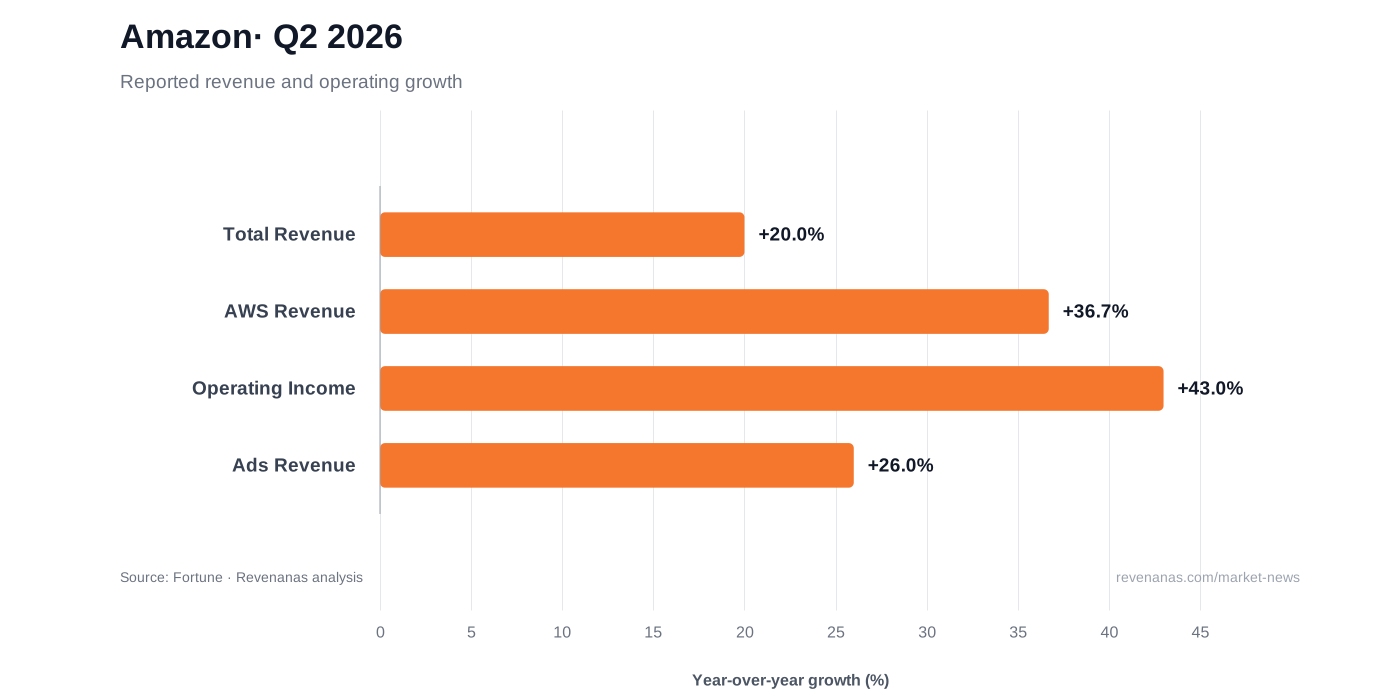
Amazon delivered faster growth across AWS, advertising and stores, while operating income expanded more quickly than revenue. The company is spending ahead of revenue because it still cannot meet AI demand through 2027. Backlog and run-rate data show durable demand, but the cash cost arrives first.
The simultaneous acceleration of AWS core and AI revenue indicates these segments are reinforcing each other rather than cannibalizing spend. Operators should note that AI workloads are driving CPU, storage, and vector database demand, which benefits AWS given its Graviton and broad infrastructure footprint.
The CapEx increase is driven primarily by higher memory costs, not a change in demand outlook. However, management explicitly stated capacity will be insufficient to meet all AI demand in both 2026 and 2027, meaning supply-side constraints will persist as a gating factor for customers provisioning large-scale AI workloads.
Andy Jassy framed AWS as being in a sustained acceleration phase, with revenue growth increasing for five consecutive quarters. He emphasized that AI and core infrastructure growth are mutually reinforcing, with AI training and inference driving additional demand for CPU compute, storage, and vector databases.
Management highlighted that the chips business has reached an annual revenue run rate of over $25B, with Trainium adoption extending beyond Anthropic and OpenAI to include startups and enterprises such as Uber and Pinterest. Graviton is now used by 98% of the top 1,000 EC2 customers, and Graviton5 is growing nearly twice as fast as Graviton4 did.
AI revenue run rate is now over $25B, growing triple-digit percentages YoY. The chips business run rate is also over $25B, growing triple-digit percentages YoY.
AWS backlog stands at $496B, growing triple digits YoY. Management stated that demand already contracted for 2028 is significant.
Jassy addressed the ROIC equation directly, noting that data center capital is spent approximately two years before monetization begins, while servers and networking equipment are purchased a few months before deployment. Servers typically break even in under three years, with useful lives of five to six years and AI capacity often contracted for at least five-year terms.
The capital cycle mismatch means free cash flow headwinds will persist in the near term as multiple data centers are built simultaneously. However, management indicated that once revenue growth outpaces incremental CapEx growth, the resulting free cash flow and return on invested capital profile becomes compelling.
Management stated that AI margins and returns are tracking slightly ahead of where core AWS was at the same stage of evolution. Jassy also noted that enterprises remain very early in using inference at scale in production applications, suggesting the current demand wave is still in its initial phase.
On capacity, Jassy was explicit: even at $220B in 2026 CapEx, Amazon will not have enough capacity to meet all AI demand in 2026, and he expects the same dynamic in 2027. He characterized the demand already visible for 2028 as striking.
Management reiterated its long-term view that AWS could become at least double a few-hundred-billion-dollar revenue business, and very possibly a trillion-dollar annual revenue business over time, with accompanying free cash flow and return on invested capital.
The raised CapEx figure and explicit capacity constraints tell operators that AI infrastructure availability will remain a competitive differentiator through at least 2027. Customers negotiating multi-year commitments now are likely to secure capacity priority, while those deferring decisions may face provisioning delays.
Anthropic, OpenAI and a broader group of enterprise customers are adopting Trainium, taking Amazon silicon beyond internal workloads. Together, Trainium for AI acceleration and Graviton for CPU workloads give infrastructure buyers an alternative to relying on one chip supplier.
Anthropic and OpenAI have made multi-year, multi-gigawatt commitments to Trainium. Revenue commitments for Trainium increased nearly 3x quarter-over-quarter.
The dual-track strategy of supporting both Nvidia and custom silicon gives AWS flexibility to serve customers who want choice. Operators should expect continued investment in both paths, with Trainium positioned as a cost-effective inference and training option for price-sensitive workloads.
The Bedrock and SageMaker AI portfolio continues to expand, with Bedrock Agents adding features such as policy controls, autonomous payments, and web search grounding. Amazon Q has added autonomous agents, a personalized activity feed, and 16 new integrations including Adobe, Moody's, and Snowflake.
Amazon Q customers include 3M, Allianz, AstraZeneca, Autodesk, BMW, Exxon, FINRA, Hyundai, Intuit, Mondelēz International, Moody's, the NBA, the NFL, Sun Life, and Southwest Airlines.
Q's integrations and customer base position it as a productivity layer across SaaS tools rather than a standalone assistant. It can centralize workflow automation across Slack, Salesforce, Jira and Teams inside one access-controlled environment.
AWS Continuum, launched in Q2, targets code vulnerability discovery and remediation using frontier models. Management noted that security is a near-universal topic in enterprise AI conversations, and expects Continuum to grow quickly.
On the advertising side, revenue reached $19.8B, up 26% YoY. Sponsored Products remains the largest offering, while agentic and conversational surfaces including Alexa for Shopping are creating new ad inventory. Shoppers clicking sponsored prompts convert 48% more often and spend 21% more on average.
The integration of ads into agentic shopping experiences represents a new monetization surface. Operators in retail media should monitor how conversion and spend metrics evolve as Alexa for Shopping usage scales, with active users nearly doubling and interactions up over 5x YoY in Q2.
Amazon Supply Chain Services launched with customers including P&G, 3M, Lands' End, and American Eagle, extending Amazon's logistics infrastructure to third-party businesses. Alexa+ expanded to Germany, Austria, France, and Brazil, and Amazon Leo is close to 400 satellites in orbit with initial service planned this year.
I would watch four things over the next two quarters:
Capacity is the one I would put first. It controls how quickly backlog becomes revenue and how much of the current AI demand Amazon can capture rather than defer.
Source:
FortuneGet AI signals in your CRM
Regulation, model launches, funding mega-rounds, acquisitions, privacy lawsuits, and compute constraints.